Competitor Monitoring: Track Every Mention of Your Competitors Across All Platforms
Your competitors are being talked about right now. On Reddit, someone is asking if there's a better alternative to their product. On LinkedIn, an executive just announced a new launch. On Twitter, their customers are publicly complaining about a bug. Are you seeing any of it?
Competitor monitoring gives you a live window into every conversation happening about your rivals. This guide explains what it is, what to track, and how to use a competitor mention tracker to turn competitor insights into your biggest growth advantage.
Why Competitor Monitoring Is Your Secret Weapon
Competitor monitoring is the practice of tracking every online mention of your competitors across social media, news, forums, and the web. It gives you real-time intelligence on their customers, campaigns, weaknesses, and growth moves, without manual research or guesswork.
Most companies study competitors by reading their website and watching their ads. That tells you what a competitor wants you to see. Competitor monitoring tells you what their actual customers think, what problems they complain about, and what features they wish they had. That's a completely different kind of intelligence.
What competitor monitoring reveals
With a monitoring tool running on your competitors, you see unhappy customers the moment they post. You see comparison threads where buyers are weighing options. You see announcement reactions in real time. And you see the gaps your competitors are failing to fill, which is exactly where your product can step in.
Competitor monitoring vs traditional research
Traditional competitive research, like reading review sites or subscribing to their newsletter, gives you a snapshot in time. Competitor monitoring is continuous. You're not catching up to where they were last quarter. You're watching what's happening today, this hour, in real time.
Monitor Competitors on Every Platform
Different platforms surface different types of competitive intelligence. A complete strategy to monitor competitor social media and web coverage covers all of them simultaneously.
Reddit is where the most honest competitor feedback lives. Users ask for product recommendations, share negative experiences, and debate which tool is worth using. Reddit monitoring for competitor keywords gives you access to buying conversations that happen nowhere else online. A single "what's a good alternative to ?" post is a direct pipeline to customers ready to switch.
Twitter/X and TikTok
These platforms are where real-time reactions happen. When a competitor launches a new feature, the response appears on Twitter within minutes. When a competitor makes a mistake, TikTok creators document it publicly. Both channels give you early signals before the story reaches blogs or news sites.
LinkedIn competitor monitoring reveals B2B strategy signals. Executive announcements, hiring sprees in specific departments, and customer success posts all hint at where a competitor is heading. If a rival is suddenly hiring 20 engineers in a new product area, that's a strategic signal worth knowing about early.
News, blogs, and the web
Press coverage, industry blog mentions, and backlink profiles tell you which media outlets cover your competitors and why. This helps you identify PR opportunities and distribution channels you may not be using yet. Mention's analysis of competitor monitoring tools shows that web coverage is consistently the most undertracked channel for competitive intelligence.
Spot Competitor Weaknesses in Real Time
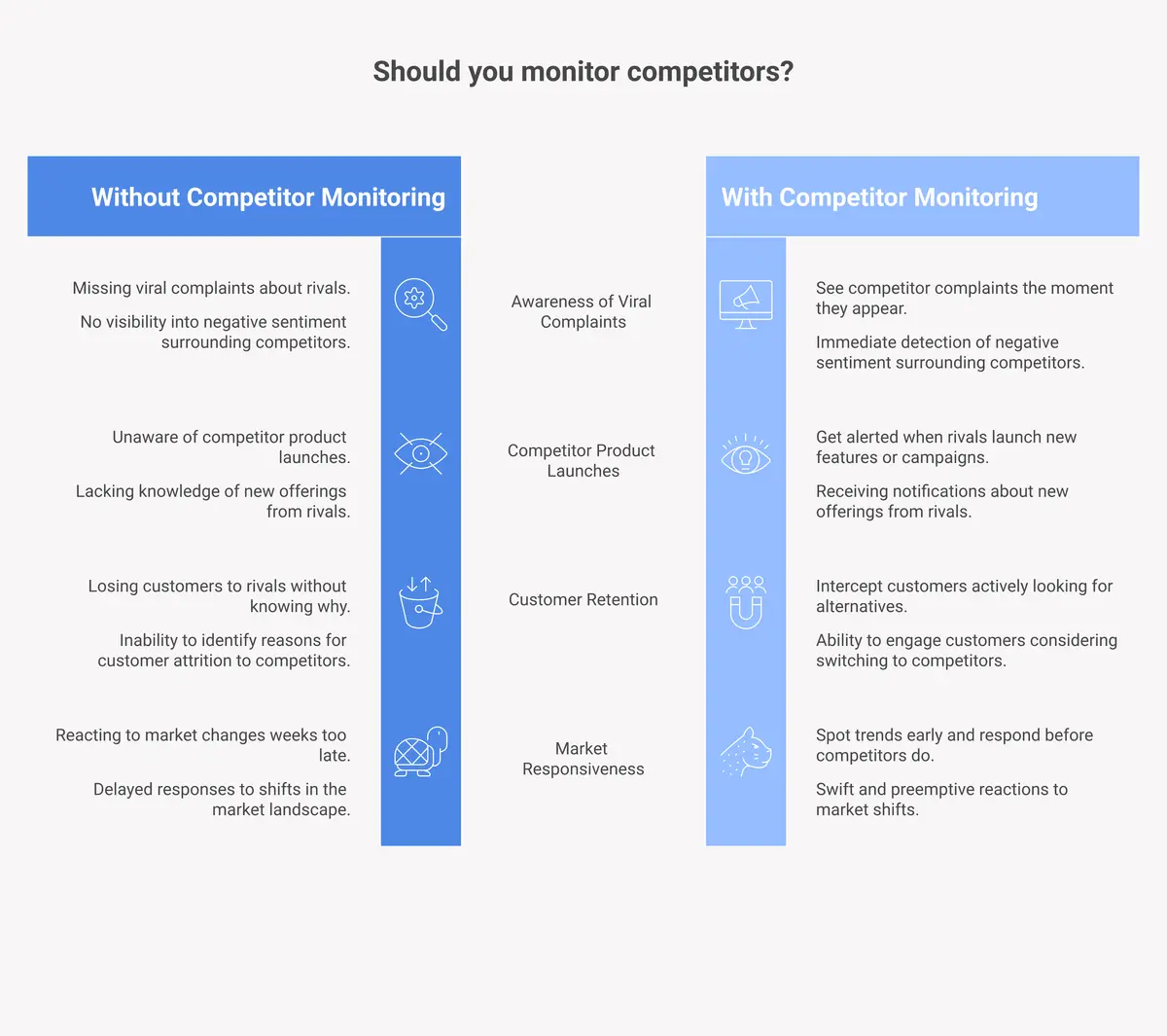
The highest-value use of competitor monitoring is finding competitor weaknesses before those customers find another solution. Every complaint, every support request, every "I wish this tool could do X" post is an opportunity for your brand.
When a customer posts publicly that a competitor's product is broken, slow, or missing a key feature, they're not just venting. They're broadcasting that they're open to alternatives. Your team can respond to that post within minutes, offer a genuine solution, and start a conversation. This is the fastest way to win new customers without spending on ads.
Finding customers ready to switch
The clearest signal is a direct comparison request: "Does anyone use ? I'm looking for something better." These posts appear on Reddit, Twitter, LinkedIn, and Facebook every day in almost every product category. Competitor monitoring catches them the moment they're published. Your team can respond with context, helpfulness, and a clear reason to try your product instead.
Negative sentiment as a lead source
When competitor mentions spike in negative sentiment, that's a window to act. A competitor app crashing during a busy period, a price increase announcement, or a policy change that upsets users, these events all generate a wave of competitor mentions. Brands with monitoring tools in place see the wave in real time and can respond to it strategically.
Track Competitor Campaigns and Launches
Competitors rarely announce their plans in advance. But their customers and media coverage reveal them quickly. Competitor monitoring lets you track launch signals before they become press releases.
Spotting product launches early
When a competitor launches a new feature, the first reactions appear on social media before any official announcement. Early users post screenshots. Influencers review it. Customers ask questions. By the time the press release drops, you've already seen the reaction and can adjust your own messaging to emphasize what your product does better.
Tracking influencer and media relationships
Which blogs, creators, and news outlets cover your competitors? Competitor monitoring surfaces these relationships over time. If a rival consistently gets coverage from a specific media outlet, that outlet covers your category. Reaching out directly with your own story becomes a targeted, informed effort instead of a cold pitch.
Benchmark Your Brand vs Competitors
Competitor monitoring isn't just about watching rivals. It's about measuring yourself against them. Share of voice, sentiment comparisons, and mention volume trends give you a clear picture of your competitive position.
Share of voice
Share of voice measures what percentage of total category conversations mention your brand. If competitors are getting three times more mentions in your niche, you have a visibility problem. Tracking this metric monthly shows whether your marketing efforts are closing the gap or falling further behind.
Sentiment benchmarking
Comparing your brand sentiment to competitor sentiment reveals positioning opportunities. If you score higher on positive sentiment but lower on mention volume, you have a great product with a visibility problem. If a competitor scores lower on sentiment despite higher volume, you can use their customers' frustrations in your messaging without mentioning them by name.
Competitive Intelligence for Marketing Teams
Competitive intelligence is the process of gathering, analyzing, and acting on information about competitors to make better business decisions. It's not espionage. It's organized attention to publicly available signals.
Crayon's competitive intelligence resource library describes competitive intelligence as one of the most underdeveloped capabilities in most marketing teams. Most companies rely on quarterly reviews of competitor websites, missing the daily signals that actually drive decisions. Some teams call it keeping an eye on competitor mentions. Others call it spy on competitor mentions. Either way, it's just structured attention to public conversations.
How marketing teams use competitor monitoring
Growth teams use it to find new acquisition channels their competitors are using. Content teams use it to identify topics competitors are being discussed for but failing to own. Product teams use it to surface feature requests customers make publicly on competitor posts. Each team gets different value from the same monitoring feed.
Agencies and multi-client monitoring
Marketing agencies use competitor brand monitoring to run competitive analysis for multiple clients from one dashboard. Instead of setting up separate tools or doing manual research per client, a single monitoring setup covers all client brands and their respective competitors simultaneously. Brand monitoring and competitor monitoring run in parallel for a complete picture of each client's market position.
How to Set Up Competitor Monitoring with mentionmind
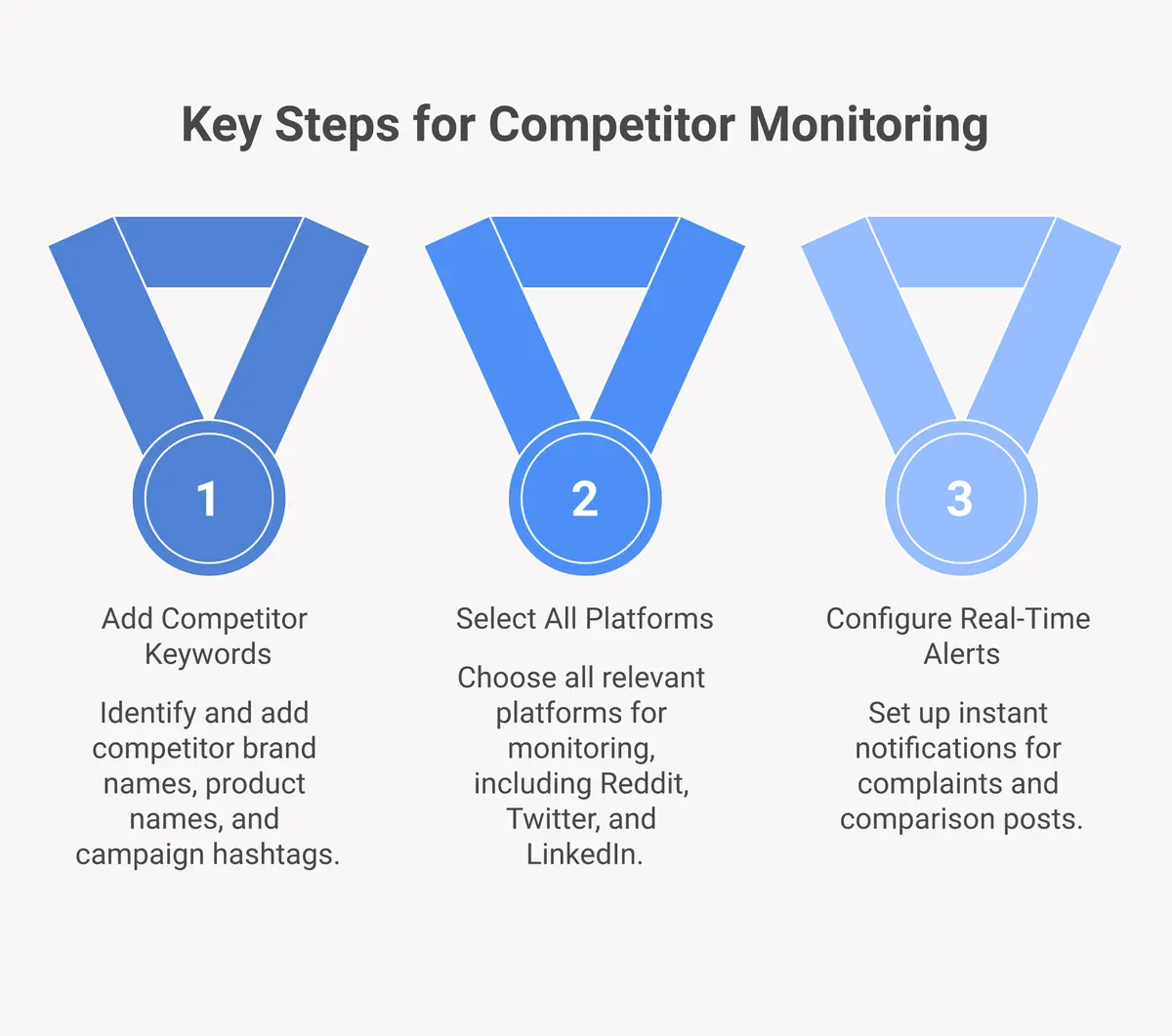
Setting up competitor monitoring in mentionmind takes less than five minutes. You add your competitor keywords, choose your platforms, and configure how you want to be notified. Here's the full setup process.
Step 1: Add your competitor keywords
Start with your top three competitors by brand name. Add their main product names and any known campaign hashtags. Include common misspellings and abbreviations that customers use. The more specific your keyword list, the more relevant your monitoring feed will be.
Step 2: Select your platforms
Choose all seven platforms mentionmind monitors: Reddit, Twitter/X, LinkedIn, TikTok, Instagram, Facebook, and the web. Competitor conversations happen across all of them. Leaving any platform out means missing a category of intelligence.
Step 3: Configure your alerts
Set real-time alerts for high-priority keywords, like direct comparison posts and competitor complaint spikes. Use daily digests for general competitive intelligence and volume tracking. Assign specific alerts to team members based on their role: product alerts to product managers, PR alerts to communications teams.
Step 4: Review and act
Schedule a daily 15-minute competitive intelligence review. Check for complaint spikes, new comparison threads, and launch signals. Create a shared team note for each week's key competitor insights. The goal isn't to collect data. It's to make decisions faster with better information.
Ready to start? Try mentionmind free for 7 days and set up competitor monitoring across all seven platforms today.
Frequently Asked Questions
What is competitor monitoring?
Competitor monitoring is the practice of tracking every online mention of your competitors across social media, news, blogs, and forums. It gives you real-time visibility into competitor weaknesses, customer complaints, product launches, and market conversations. Tools like mentionmind automate this process across seven platforms from a single dashboard.
How is competitor monitoring different from competitive analysis?
Competitive analysis is a periodic review of competitor strategy, usually done quarterly or annually. Competitor monitoring is continuous. You track daily mentions, real-time sentiment, and live conversations rather than looking at a historical snapshot. Most teams benefit from doing both: ongoing monitoring for daily signals and periodic deeper analysis for strategic planning.
Can competitor monitoring help me find new customers?
Yes. Competitor monitoring is one of the fastest ways to find customers who are actively looking for alternatives. Posts like "looking for a better alternative to " appear on Reddit, Twitter, and LinkedIn every day in most product categories. A monitoring tool catches these posts in real time so your team can respond before anyone else does.
What platforms should I monitor for competitor mentions?
You should monitor Reddit, Twitter/X, LinkedIn, TikTok, Instagram, Facebook, and the web. Each platform surfaces different types of intelligence. Reddit shows unfiltered customer opinions. LinkedIn reveals B2B strategic signals. Twitter captures real-time launch reactions. The web includes press coverage and industry blog mentions. A tool like mentionmind covers all seven simultaneously.
How many competitors should I monitor?
Start with your top three direct competitors. This gives you enough data to spot patterns without overwhelming your team with volume. Once you have a workflow in place, you can expand to secondary competitors and adjacent categories. Review the mentionmind pricing page to see how many monitoring topics are included in each plan.