Search Across Every Social Platform at Once: Your Social Media Search Engine
Every social platform has its own search bar. But each one only shows you what's on that platform. To find out what people are saying about your brand across Reddit, Twitter, LinkedIn, TikTok, Instagram, and Facebook at the same time, you need a social media search engine.
This guide explains what a social media search engine is, why cross-platform search is fundamentally different from native platform search, and how to use it for brand monitoring, lead generation, and competitive intelligence.
Why You Need a Social Media Search Engine
A social media search engine is a tool that searches across multiple social platforms simultaneously using a single keyword query. Instead of opening Twitter, then Reddit, then LinkedIn, then TikTok one by one, you type a keyword once and see results from all platforms in a unified feed.
This matters because conversations about your brand, your competitors, and your industry don't happen on one platform. DataReportal tracks over 5 billion social media users worldwide, spread across dozens of platforms. Your audience is not all in one place. A social media search tool that covers all of them gives you a complete picture instead of a fragment of one.
What you can't find without cross-platform search
Without a cross-platform social media search engine, you miss entire categories of conversation. A Reddit thread comparing your product to a competitor. A LinkedIn post from an executive mentioning your brand. A TikTok video tagging your product in a review. Each of these lives on a different platform with a different native search experience. Most brands discover these conversations days or weeks late, if at all.
Who benefits from a social media search engine
Marketing teams use it to track brand mentions and campaign performance across channels. Sales teams use it to find active buyers comparing products in their category. PR teams use it to monitor news mentions and crisis signals. Product teams use it to surface feature requests and real user feedback from everywhere customers talk.
Search Reddit, Twitter, LinkedIn, TikTok, Instagram and Facebook at Once
Each major social platform uses a different search algorithm, different content formats, and different community norms. A social media search engine cuts through these differences and returns unified results.
Why each platform adds unique value
Reddit surfaces the most candid opinions. Twitter shows real-time reactions. LinkedIn reveals professional and B2B conversations. TikTok and Instagram surface visual content and creator mentions. Facebook captures community group discussions. Searching across all of them at once lets you search social media mentions with full coverage rather than hoping the most important conversation happened to be on the platform you checked last.
How cross-platform search changes your workflow
The traditional workflow is manual and slow. You log into Twitter, run a search, check the results, switch tabs, log into Reddit, run the same search, check those results, and repeat for every platform. A social media search tool replaces this entire process with a single query. Want to search reddit twitter instagram linkedin and tiktok at once? One keyword entry does it. What used to take 30 minutes takes 30 seconds.
Find Historical Mentions
Most native social platform searches only return recent results. A social media search engine can go further back, surfacing conversations from weeks, months, or longer ago that native search would never return.
Historical data is valuable in ways that real-time monitoring alone can't replace. When you're entering a new market, you want to know what people were saying before you arrived. When you're investigating a reputation issue, you want to understand when it started and how it evolved. When you're doing competitive research, you want to see how sentiment has shifted over time, not just today's snapshot.
Using historical search for product research
Searching historical social media mentions for the problem your product solves reveals the exact language your customers use to describe their pain points. This is the most direct path to authentic messaging. You're not guessing what resonates. You're reading what real people wrote before they knew your product existed.
Tracking how narratives evolve over time
Historical cross-platform search lets you map how a conversation or perception changed over time. Did your brand's sentiment improve after a product update? Did a competitor's negative press spike following a specific event? This kind of timeline analysis is only possible with access to historical mentions across platforms, not just today's feed.
Monitor Trends Across Platforms
Beyond searching for specific keywords, a social media search engine shows you trends. Volume spikes, sentiment shifts, and platform distribution changes all tell you something important about how conversations in your category are moving.
Identifying emerging topics early
When a new topic starts trending across platforms simultaneously, it's a signal that something significant is happening in your market. A social media search engine that tracks keyword volume over time lets you spot these emerging conversations early, before they become mainstream news stories. Early awareness means you can create content, adjust positioning, or respond before competitors do.
Comparing platform engagement patterns
Different topics trend differently across platforms. A technical feature update might generate more LinkedIn discussion than Twitter activity. A viral complaint might spread faster on TikTok than Reddit. Understanding which platforms carry which types of conversations for your brand tells you where to invest your engagement time and which channels to monitor most closely.
How to Search for Brand Mentions Across Social Media
Searching for brand mentions across social media using a dedicated search engine is straightforward. The key is setting up your keyword list to capture every variation of how people reference your brand.
Keywords to include
Start with your exact brand name and product names. Add common misspellings and abbreviations. Include your founder's name if they're public-facing. Add your main competitors by name. Then add category keywords that describe the problem your product solves, because many of the most valuable conversations won't mention you by name at all. They'll describe a problem you solve.
Filtering results for quality
When you search across social platforms for a common brand name, you can return thousands of results. Use filters to narrow down to what matters. Filter by platform to focus on the channels most relevant to your audience. Filter by sentiment to surface negative mentions that need a response. Filter by date to see only recent conversations. Filter by engagement level to prioritize high-reach posts over low-visibility ones.
Social Media Search Engine vs Platform Native Search
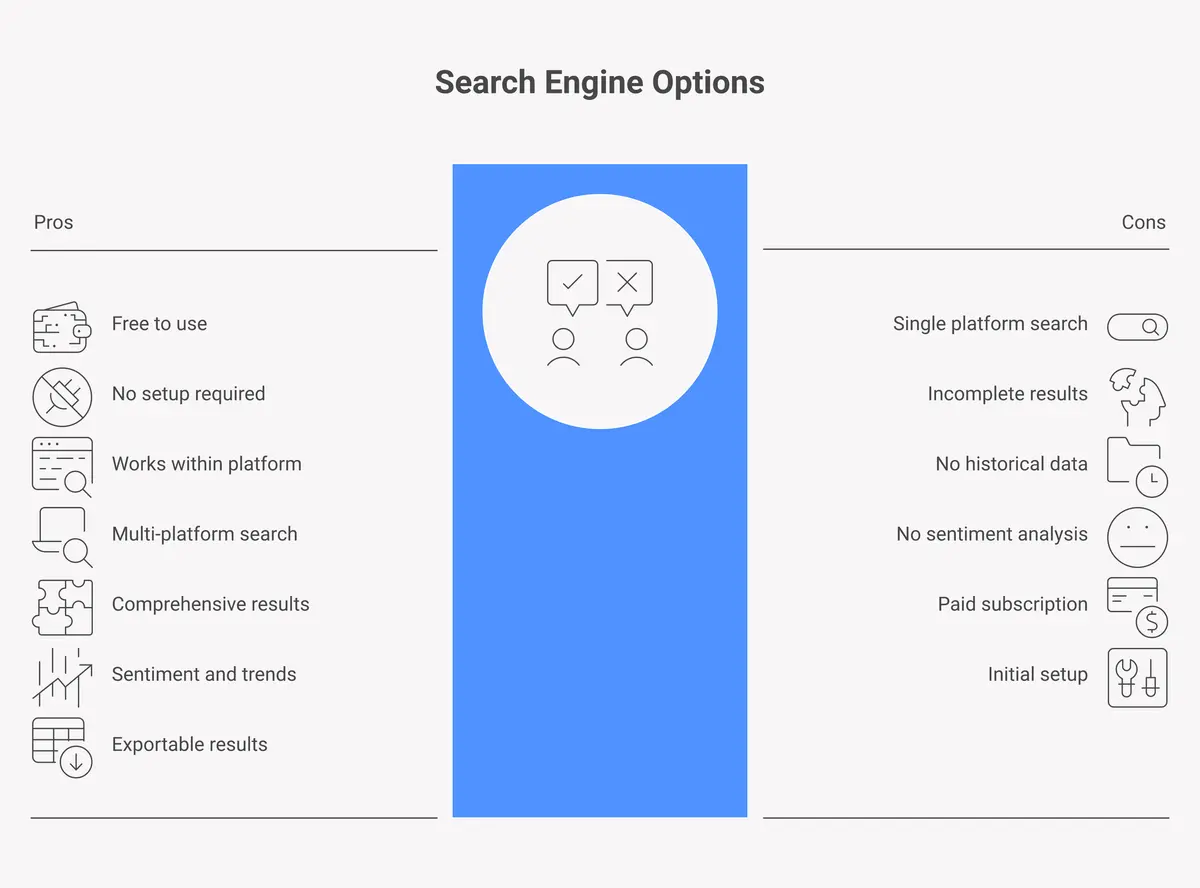
Every social platform has a native search feature. Twitter lets you search tweets. Reddit has its own search bar. LinkedIn has a people and post search. Each one works within its own ecosystem. A dedicated social media search tool covers all of them, with capabilities that native search can't match.
Backlinko's social media user data shows that most adults actively use three to five social platforms regularly. If your audience is on five platforms and your search tool only covers one, you're missing 80% of the conversation by default.
What native search misses
Native platform search filters results algorithmically, which means it doesn't show you everything. Older posts get buried. Low-engagement content disappears from results even if it's relevant. Comments in threads rarely surface. Cross-platform comparisons are impossible. And there's no sentiment analysis, no trend tracking, and no export capability in any native social search interface.
What a dedicated social media search tool adds
A dedicated social media search engine gives you complete coverage, historical access, sentiment classification, trend tracking, and team collaboration features. It doesn't filter results algorithmically to serve a platform's engagement goals. It returns every matching mention and lets you decide what matters. Combined with brand monitoring and Reddit monitoring for your most candid feedback channel, it gives you the most complete brand intelligence available.
Ready to search across every social platform at once? Try mentionmind free and run your first cross-platform brand search in minutes.
Frequently Asked Questions
What is a social media search engine?
A social media search engine is a tool that searches across multiple social media platforms simultaneously using a single keyword query. Instead of searching Reddit, Twitter, LinkedIn, TikTok, Instagram, and Facebook separately, you search once and get unified results from all platforms. Tools like mentionmind function as a social media search tool combined with real-time monitoring and alerts.
How is searching social media mentions different from social media monitoring?
Social media monitoring runs continuously in the background and alerts you when new mentions appear. Cross-platform search is on-demand: you run a query and get historical and current results for a keyword. Both are useful for different purposes. Monitoring catches mentions as they happen. Search lets you investigate a topic across time and platforms retroactively. mentionmind combines both capabilities in one tool.
Can I search historical social media posts?
Yes, with a dedicated social media search engine. Native platform search tools typically return recent results only and miss older posts. A dedicated tool with historical data access lets you search social media mentions from weeks or months back. This is particularly useful for competitive research, market entry analysis, and tracking how brand perception has changed over time.
What platforms does a social media search engine cover?
The best social media search tools cover all major platforms in a single query. mentionmind lets you search across Reddit, Twitter/X, LinkedIn, TikTok, Instagram, Facebook, and the web simultaneously. You can filter results by platform, date, sentiment, or keyword to focus on the most relevant conversations for your brand or research goal.
How do I search Reddit, Twitter, and Instagram at once?
The easiest way is to use a cross-platform social media monitoring tool like mentionmind. You enter your keyword once and the tool searches Reddit, Twitter/X, LinkedIn, TikTok, Instagram, Facebook, and the web in parallel. Results appear in a single unified feed that you can filter by platform. See the pricing page to find the plan that matches your search volume and platform needs.