Best Social Media Monitoring Tools for Marketing Teams in 2026
Most social media monitoring tools were built for individual users, community managers, or single-platform workflows. They work fine for tracking Twitter mentions or scheduling Instagram posts. They fall short when a marketing team needs to know what's being said about a brand across every platform simultaneously, share that visibility with multiple team members, and report the results to stakeholders.
This guide reviews the best social media monitoring tools specifically for marketing teams: the criteria that matter at team scale, the platform coverage gaps to watch for, and the honest tradeoffs between the leading options in 2026.
What Makes the Best Social Media Monitoring Tools Right for Marketing Teams?
The requirements differ from individual brand monitoring tools. A marketing team needs different capabilities from an individual brand manager or founder. Marketing teams need tools that scale to multiple users, cover the full range of platforms where brand conversations happen, and produce reports that can be shared with clients or leadership. What works for one person monitoring one platform rarely works for a team managing multiple brands across seven platforms.
Platform coverage as a marketing requirement
Platform coverage is the most important criterion that individual-focused tools consistently underdeliver on. A marketing team managing a consumer brand needs visibility across Twitter/X (real-time reactions), Reddit (unfiltered community discussion), LinkedIn (professional and B2B reputation), Instagram (visual brand content and influencer activity), Facebook (community engagement and ad reaction), TikTok (emerging brand trends), and the web (news, blogs, forums). Tools that cover only four or five of these platforms leave blind spots in exactly the places where brand conversations often originate.
Brand monitoring that covers all seven platforms gives marketing teams a complete picture of what's being said about their brand, where it's being said, and how it's spreading across channels. Partial coverage means partial visibility, and in a PR crisis, partial visibility can mean missing the platform where the story actually started.
The difference between individual and team-grade tools
Individual tools are designed for one person to check manually. Team-grade tools are designed for shared visibility, role-based access, and workflow integration. The practical differences include shared dashboards that multiple users can access simultaneously, alert routing that sends different types of mentions to the right team member, and report templates that teams can use for recurring stakeholder updates. Most individual-focused tools can technically be used by multiple people, but they weren't designed for it, and the workflow shows.
How Do Top Social Media Monitoring Tools Compare on Platform Coverage?
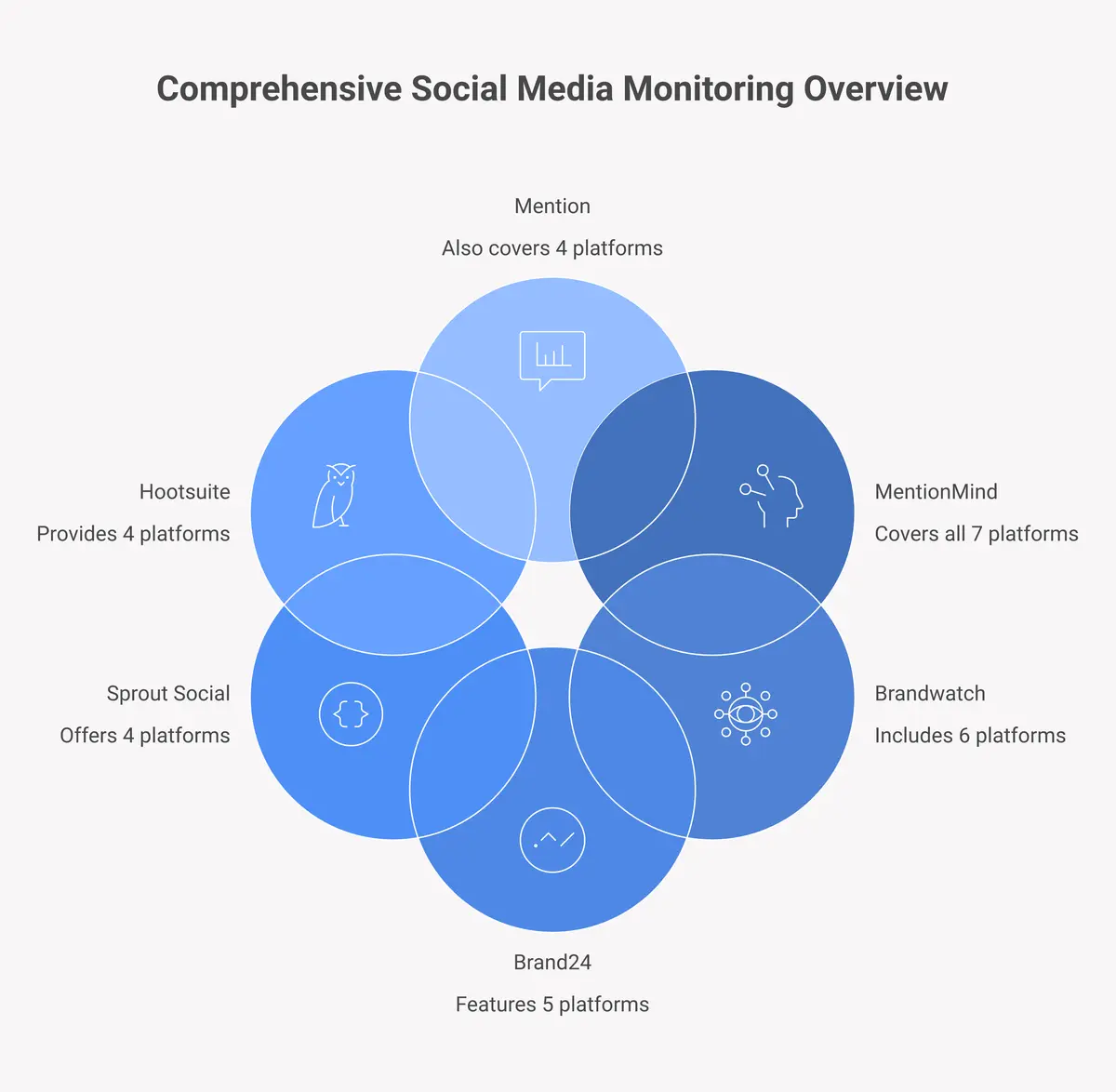
Platform coverage is where the top social media monitoring tools diverge most significantly. The comparison below shows how leading tools perform on the seven platforms that marketing teams need to cover. The differences are more significant than most tools advertise on their feature pages.
Why 7-platform coverage matters for marketing teams
Brand conversations do not respect platform boundaries. A product complaint posted on Reddit is shared to Twitter. A Twitter crisis becomes a LinkedIn case study. An influencer campaign on Instagram generates reactions on TikTok. A news article about your brand gets discussed in industry forums. Marketing teams that only monitor four or five platforms are systematically missing a portion of every brand conversation, and that missing portion is often where the most analytically useful signal lives. Reddit hosts the most detailed brand discussions. LinkedIn hosts the most professionally consequential ones.
The platforms most often missed by monitoring tools
LinkedIn and TikTok are the platforms most commonly absent from social media monitoring tools. LinkedIn is excluded from most tools because it has historically been harder to access programmatically, despite being the most important platform for B2B brands and the professional conversation layer that shapes how executives, analysts, and industry journalists interpret brand news. TikTok monitoring is absent from most established tools because the platform's growth outpaced many tool developers. Both gaps matter significantly for marketing teams, and the tool you choose should cover both explicitly.
What Criteria Should Marketing Teams Use to Evaluate These Tools?
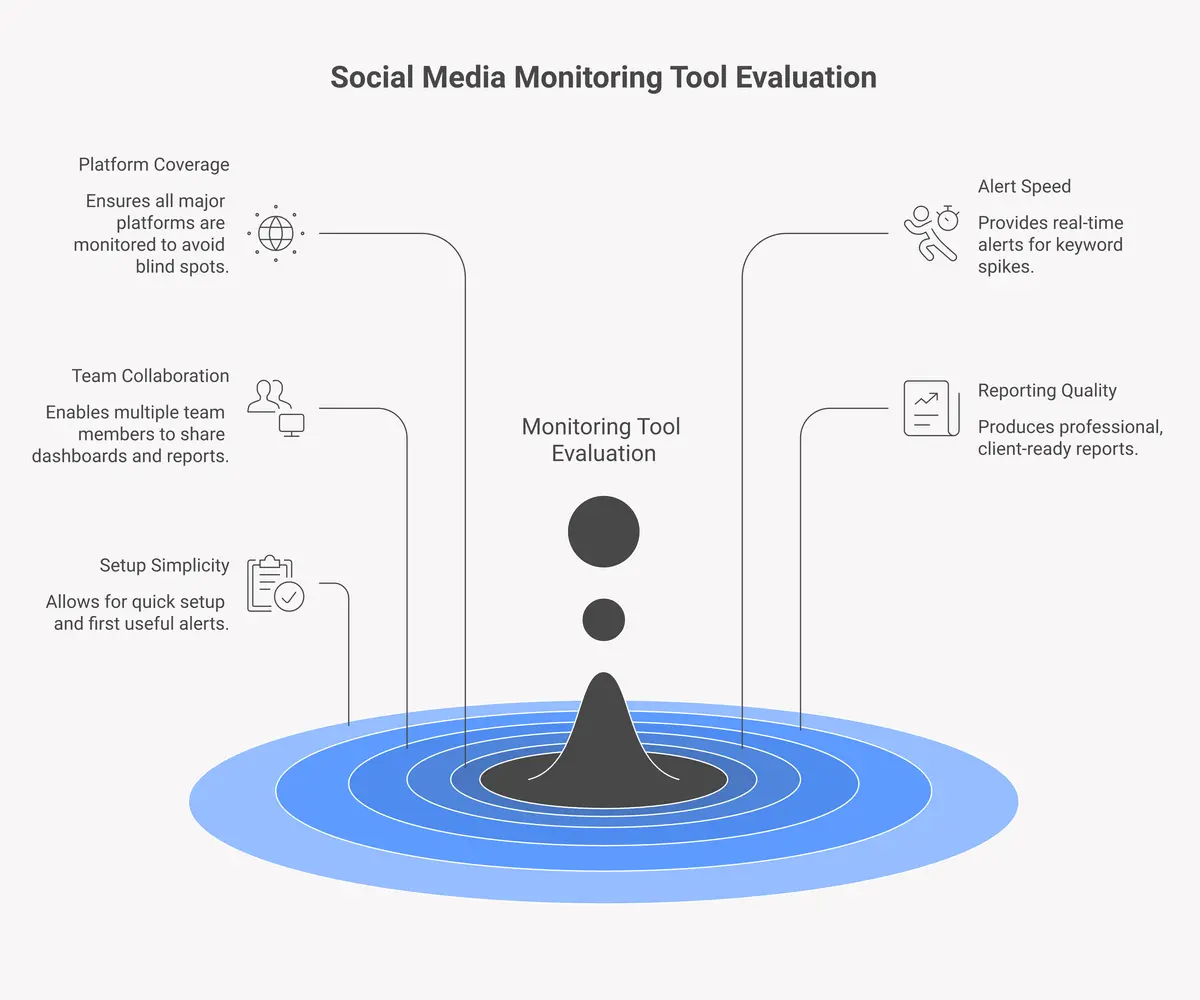
Five criteria separate the best social media monitoring tools for marketing teams from the tools that work well for individuals. Each criterion maps to a real workflow problem that marketing teams encounter when they scale monitoring from one person to a team.
Platform coverage
Does the tool cover all seven major platforms? Verify this specifically for LinkedIn and TikTok, since these are the two platforms most tools claim coverage for but deliver inconsistently. Ask whether coverage includes keyword tracking or only direct handle mentions, since untagged brand mentions are often the most useful signal.
Alert speed and threshold configuration
Does the tool send real-time alerts or batch alerts? For a crisis monitoring use case, hourly batches are too slow. Look for tools that can alert within minutes of a spike and allow custom volume thresholds so you're not flooded with low-value notifications. Volume spike alerts, not just individual mention alerts, are the more useful mechanism for marketing teams tracking brand health.
Team collaboration features
Can multiple team members access the same dashboard simultaneously? Does the tool allow role-based access so junior team members see different data from senior managers? Can alerts be routed to different team members based on keyword or platform? These features are non-negotiable for teams of more than two people, yet many tools still treat monitoring as a single-user workflow.
Reporting quality
Can the tool produce reports that marketing teams can share with clients or leadership without reformatting? Look for scheduled report exports, white-label options for agencies, and dashboard sharing links. Teams that need to present monitoring results monthly shouldn't be manually assembling screenshots into a slide deck.
Setup speed and ongoing maintenance
How long does it take to go from signup to first useful alert? Some tools require significant configuration before they deliver value. Marketing teams, particularly agencies onboarding new clients, benefit from tools that can be set up in under an hour and don't require technical resources to maintain keyword sets and alert configurations.
The Best Social Media Monitoring Tools for Marketing Teams Reviewed
The following reviews focus on how each tool performs specifically for marketing teams, not individual users. Each evaluation reflects the five criteria above, with particular attention to platform coverage completeness and team workflow support.
MentionMind
MentionMind covers all seven platforms (Twitter/X, Reddit, LinkedIn, Instagram, Facebook, TikTok, and the web) from a single dashboard, which is the complete coverage marketing teams need without requiring multiple tool subscriptions. Keyword-based alerts fire across all platforms simultaneously, so a brand mention on Reddit and a mention on LinkedIn generate the same alert regardless of where the conversation is happening. The platform is designed for team use with shared dashboards and multi-user access. For marketing teams that need complete coverage without platform gaps, MentionMind covers the full monitoring stack in one place. Review plan options and start monitoring all 7 platforms immediately.
Brandwatch
Brandwatch is a well-established enterprise monitoring platform with strong analytics capabilities and deep historical data access. It covers six of the seven major platforms, missing TikTok in its core monitoring coverage. The platform is best suited for large enterprise marketing teams with dedicated analytics resources, as the interface and pricing reflect an enterprise buyer. For smaller marketing teams or agencies that need to onboard clients quickly, the setup time and cost may exceed what the use case requires.
Brand24
Brand24 is a solid mid-market option covering five platforms: Twitter/X, Reddit, Instagram, Facebook, and the web. It misses LinkedIn and TikTok. For consumer brands where LinkedIn monitoring is less critical, Brand24 provides good coverage at a reasonable price point. Its mention feed is well-organized and the sentiment analysis is actionable. For B2B brands or any team where professional LinkedIn conversations matter, the LinkedIn gap is a real limitation.
Sprout Social
Sprout Social is primarily a social media management platform, with monitoring features built as an extension of its publishing workflow. It covers Twitter/X, LinkedIn, Instagram, and Facebook. It doesn't cover Reddit, TikTok, or the web in its monitoring features. For marketing teams that use Sprout Social for scheduling and engagement, the built-in monitoring is a useful supplement. For teams that need monitoring as their primary use case with broad platform coverage, Sprout Social's monitoring depth doesn't match what dedicated monitoring tools provide.
Mention
Mention covers Twitter/X, Reddit, Instagram, Facebook, and limited web monitoring. Like Brand24, it misses LinkedIn and TikTok. Mention is a well-regarded tool for its core platforms and has a clean interface that new users can navigate quickly. The web monitoring component is less comprehensive than dedicated web monitoring tools. For marketing teams where LinkedIn visibility is important, Mention's coverage gap in that platform is significant.
How Do Marketing Teams Build a Complete Monitoring Setup?
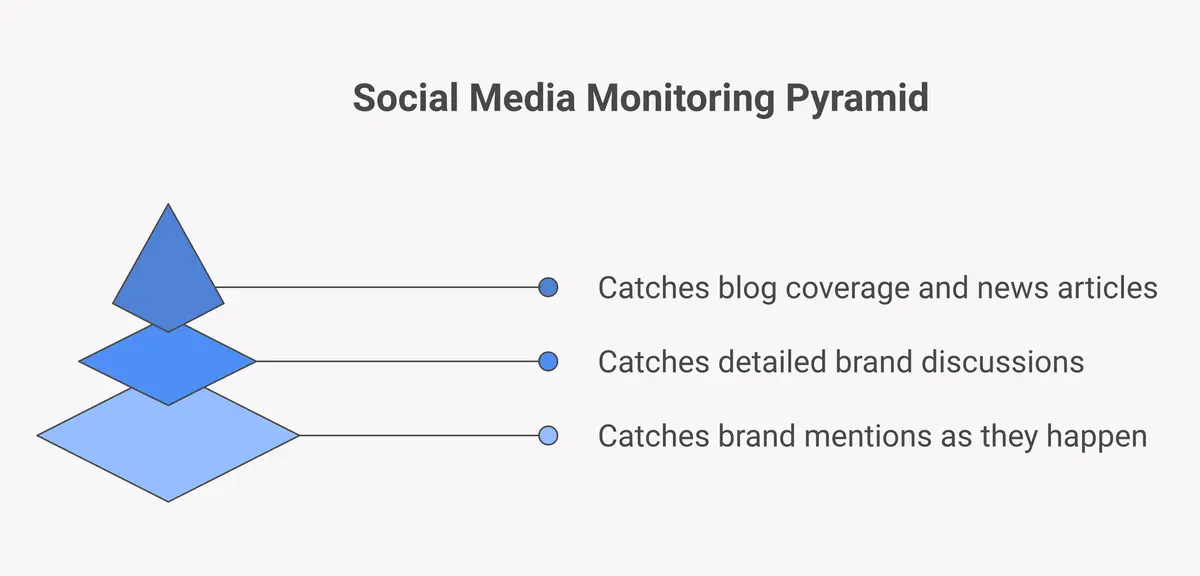
The most effective social media monitoring setups for marketing teams work in three layers. Each layer serves a different monitoring purpose, and the complete picture comes from combining all three rather than relying on any single layer.
Layer 1: Real-time social platforms
Twitter/X, Instagram, and TikTok form the real-time layer: fast-moving, high-volume, and where brand conversations start. Configure volume spike alerts for these platforms so you're notified when mention rates increase significantly relative to your baseline. This is the early warning layer for emerging issues and the feedback layer for campaign performance.
Layer 2: Analytical platforms
Reddit, LinkedIn, and Facebook form the analytical layer: slower-moving, higher depth, and where brand conversations develop nuance and permanence. Reddit threads about your brand rank in Google searches for months. LinkedIn posts from industry analysts shape professional perception. Competitor monitoring on these platforms reveals how your competitors are being discussed relative to you in the conversations where buying decisions are actually influenced.
Layer 3: Web and news
Web monitoring covers news sites, industry blogs, and forums that sit outside the major social platforms. This layer catches trade publication coverage before it reaches mainstream media, industry blog posts that rank in search, and niche community discussions that don't appear on social platforms at all. Web monitoring bridges the gap between social listening and traditional media monitoring.
How Should Marketing Teams Choose Between These Tools?
The choice between the top social media monitoring tools for marketing teams comes down to three questions: What platforms do you need to cover? How many users need shared access? And what budget reflects the monitoring's business value?
For marketing teams that need complete 7-platform coverage, including LinkedIn and TikTok, the choice is straightforward: MentionMind is the only option in this review that covers all seven. For teams that have already excluded LinkedIn from their monitoring requirements (typically pure B2C brands with no enterprise audience), Brand24 or Mention provide solid 5-platform coverage at a lower price point. Sprout Social and Brandwatch are better evaluated as part of a broader marketing technology decision rather than as standalone monitoring tools.
For agencies managing multiple client brands, the key question is whether the tool supports client-separated dashboards and user access controls. Most tools charge per keyword or mention volume rather than per user, which makes agency pricing models easier to evaluate once you know your typical client keyword volume.
The bottom line: start with the platform coverage requirement. If you need all seven platforms, your tool list is short. If you can accept five platforms, you have more options. Never choose a tool based on price and then discover it doesn't cover the platforms where your brand's most important conversations are happening. Start monitoring all 7 platforms with MentionMind and cover your complete brand conversation from day one.
Frequently Asked Questions
What is the best social media monitoring tool for marketing teams in 2026?
The best social media monitoring tool for marketing teams depends primarily on platform coverage requirements. For teams that need complete coverage across all seven major platforms (Twitter/X, Reddit, LinkedIn, Instagram, Facebook, TikTok, and the web), MentionMind is the only tool that covers all seven from a single dashboard. For teams that don't require LinkedIn or TikTok monitoring, Brand24 and Mention offer solid five-platform coverage at a lower price point.
What platforms should a social media monitoring tool cover for marketing teams?
Marketing teams need monitoring across seven platforms: Twitter/X for real-time reactions and journalist activity, Reddit for detailed brand discussions and community opinion, LinkedIn for B2B reputation and professional commentary, Instagram for visual campaign monitoring and influencer activity, Facebook for community engagement and ad reactions, TikTok for emerging brand trends and viral content, and the web for news, blogs, and forum coverage. Tools that cover fewer than seven of these platforms leave meaningful gaps in brand visibility.
How is social media monitoring different from social media management?
Social media management tools (like Hootsuite or Buffer) focus on publishing, scheduling, and engaging with content your brand creates. Social media monitoring tools focus on tracking what other people are saying about your brand across all platforms, including conversations that don't tag your handle. Most management tools include limited monitoring as a secondary feature, but monitoring-first tools provide significantly broader coverage and more useful alert configurations for teams focused on brand listening rather than content publishing.
Can one person manage social media monitoring for a large brand?
One person can manage the monitoring tool setup and configuration. But at scale, effective monitoring requires a team approach: different team members monitoring different platforms or handling different alert tiers, a defined escalation process for significant mentions, and reporting workflows that move information to the people who need it. The monitoring tool should support team workflows with shared dashboards and role-based access, not assume that one person reads every alert manually.
How much should marketing teams budget for social media monitoring tools?
Social media monitoring tool pricing typically scales with mention volume and keyword count rather than user count. For small to mid-size marketing teams monitoring one to three brands, costs typically range from $50 to $300 per month for a capable tool. Enterprise teams or agencies monitoring multiple brands simultaneously will find pricing in the $300 to $1,000+ per month range. The business value calculation should weigh the tool cost against the cost of missing a brand crisis or making campaign decisions without complete data.