Brand Sentiment Analysis Across 7 Platforms: A Complete Playbook
Your brand has a different reputation on Reddit than it does on LinkedIn. The same company, the same products, the same team, but two completely different emotional tones in two different communities. That's not a coincidence. It's the reality of multi-platform social media sentiment.
Brand sentiment tracking tells you not just whether people feel positively or negatively about your brand, but where those feelings are concentrated, what triggers them, and how to respond. This playbook covers the full analytical workflow for marketing and brand teams who want to turn sentiment data into strategic decisions.
What Is Brand Sentiment Tracking and Why Does It Vary by Platform?
Brand sentiment tracking is the practice of classifying brand mentions as positive, neutral, or negative, then analysing how those classifications change over time, across platforms, and in response to specific events. It goes beyond counting mentions: it tells you how people feel about what they're saying. The reason sentiment varies dramatically by platform is that each platform has a different community culture, different norms for how people express opinions, and different audiences with different relationships to your brand.
Why platform context changes sentiment signal
A complaint on LinkedIn reads very differently from a complaint on Reddit, even if both are about the same product issue. The LinkedIn version is typically framed professionally, often with context about business impact and a tone that invites dialogue. The Reddit version might be blunt, detailed, and upvoted by hundreds of users who have the same problem. Both are negative sentiment, but they carry different urgency, different audiences, and different required responses.
This means aggregating sentiment across all platforms into a single score can be misleading. A sharp rise in negative Reddit sentiment that's partially offset by positive Instagram mentions might look neutral in an averaged view but actually represents a serious product perception problem in one community. Effective brand monitoring tracks sentiment per platform, not just in aggregate.
The three sentiment categories and what they mean
Positive sentiment means people are praising your brand, recommending your product, or expressing satisfaction. Neutral sentiment means people are discussing your brand factually without strong emotion, often in comparisons, news coverage, or category discussions. Negative sentiment means people are criticising, complaining, or expressing disappointment. Each category requires a different response workflow, which the playbook section below covers in detail.
How Sentiment Differs Across the 7 Platforms
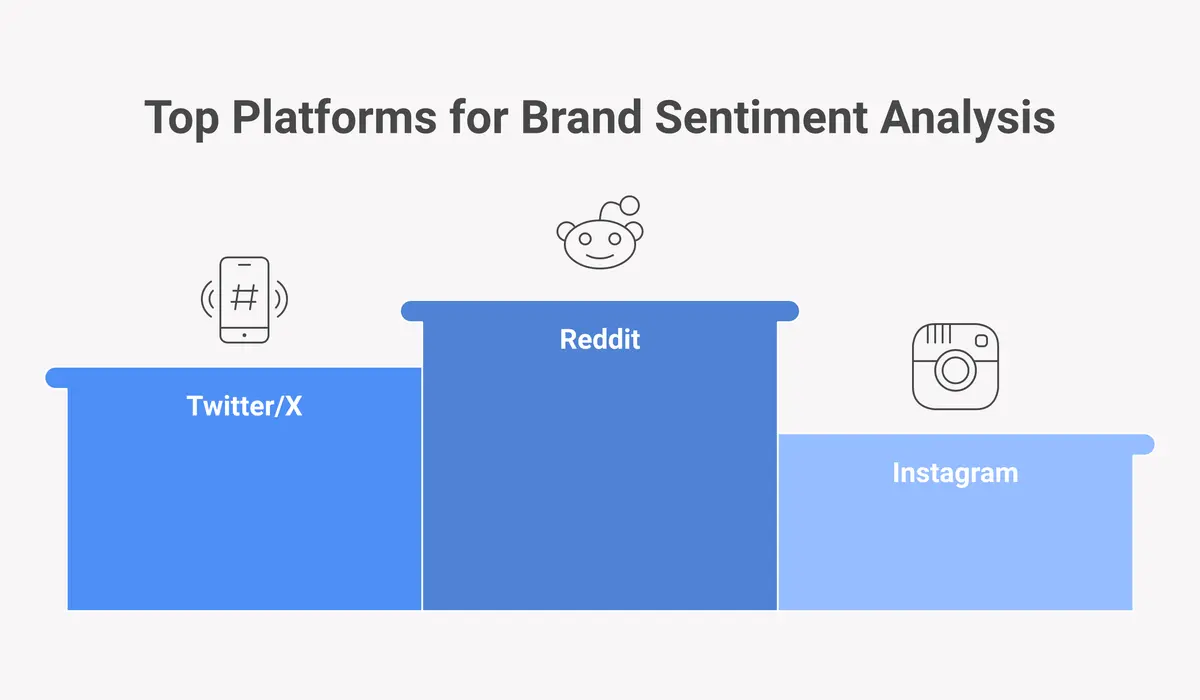
Understanding the character of sentiment on each platform helps you calibrate your interpretation of the data. The same sentiment score means different things on Reddit than on Instagram. Here's how each platform's community culture shapes the brand sentiment signal it produces.
Reddit: the most honest sentiment signal
Reddit users are notoriously direct. When they like something, they say so clearly. When they don't, they explain exactly why in detail. Reddit sentiment tends to be highly specific: users will describe the exact feature that frustrated them, the exact scenario where the product failed, and compare it directly to what competitors do better. This specificity makes Reddit the richest source of product improvement intelligence, and the most unforgiving environment for brands that ignore feedback.
LinkedIn: professional reputation sentiment
Sentiment on LinkedIn is shaped by professional stakes. People write more carefully because their professional reputation is attached to their posts. This makes LinkedIn sentiment slower to turn negative, but when it does, the audience is more influential: executives, investors, potential partners, and enterprise buyers. A negative LinkedIn conversation about your brand carries more B2B weight than the same sentiment on any other platform.
Twitter/X: the real-time mood indicator
Twitter sentiment is reactive and fast. It spikes in response to events: a product launch, a controversial statement, a PR issue. Twitter is where sentiment shifts happen first, often before they appear on any other platform. For crisis monitoring and campaign pulse tracking, Twitter sentiment is the leading indicator. Its limitation is that the spikes are often short-lived; Twitter sentiment normalises faster than Reddit threads, which tend to stay indexed and discoverable for longer.
Instagram and TikTok: visual sentiment
Sentiment on Instagram and TikTok is heavily influenced by visual content and creator culture. Positive sentiment here often takes the form of product feature highlights, unboxing videos, and aesthetically pleasing brand showcases. Negative sentiment can spread very fast if a creator with a large following makes a critical video. The tone tends to be more emotional and less analytical than Reddit or LinkedIn, which means it reflects consumer brand affinity more than considered professional opinion.
How Do You Benchmark Brand Sentiment Over Time?
Benchmarking brand sentiment over time means establishing a baseline for your normal positive/negative/neutral ratio, then tracking how that ratio changes in response to specific events, campaigns, and competitive moves. Without a baseline, you can't tell whether a current sentiment reading represents an improvement, a decline, or simply your normal state.
Setting your sentiment baseline
Your baseline should cover at least 30 days of mention data before any major campaign or event. During this period, calculate your average positive percentage, neutral percentage, and negative percentage per platform. Note the typical volume per day. This becomes your reference point. Any significant deviation from these numbers, either in ratio or volume, signals something worth investigating.
Use competitor monitoring to run the same baseline for your top two or three competitors. Knowing their typical sentiment ratios gives you a competitive benchmark: if your positive percentage is lower than theirs, you know you're losing the perception game even before a specific incident occurs.
What to look for in sentiment trend data
Slow sentiment drift is often more dangerous than sharp spikes, because it doesn't trigger immediate alerts. If your positive ratio declines by 3-4 percentage points over six months, it may reflect a systemic product or messaging problem that no single event caused. Trend charts showing sentiment over time are essential for catching this kind of gradual shift before it becomes a crisis.
The Sentiment Response Playbook
Brand sentiment data is only useful if it drives action. The response playbook defines what to do when you detect each sentiment type, so your team has clear workflows rather than ad hoc reactions to individual mentions.
Responding to negative sentiment
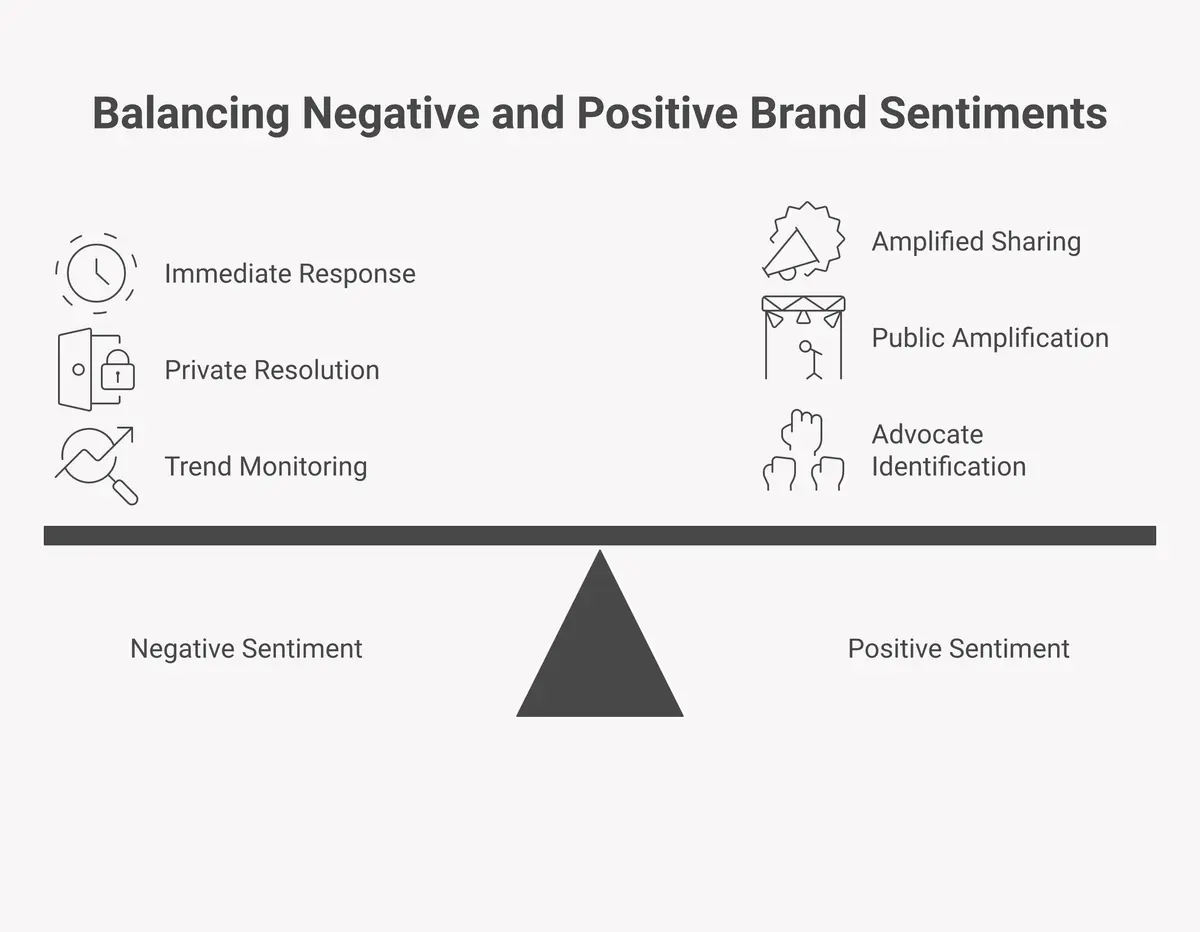
Negative sentiment requires a response within 24 hours on most platforms. Acknowledge the issue publicly so that people who see the original mention also see that you responded. Move the detailed resolution to a private channel (DM, email, support ticket) to avoid a public back-and-forth that can escalate. After resolution, monitor the original mention and surrounding conversation for follow-up posts. Flag trending negative sentiment to your product or communications team if it appears across multiple platforms simultaneously, because cross-platform negative trends signal systemic issues rather than isolated complaints.
Using positive sentiment strategically
Positive mentions that appear organically are among your most valuable content assets. Screenshot them, save them, and use them in testimonials, case studies, and campaign materials. Identify the users behind positive mentions as potential brand advocates for ambassador programs or referral initiatives. Thank creators when it's authentic and appropriate. A brand that actively engages with its positive sentiment community compounds the effect of every organic recommendation.
Monitoring neutral sentiment for directional shifts
Neutral mentions don't require immediate action, but they require monitoring for direction. A high volume of neutral mentions can shift positive or negative in response to a single event. Establishing automated alerts for sudden neutral-to-negative shifts lets you intervene before a neutral conversation becomes a reputation problem. Check your monitoring plan options to set up real-time sentiment alerts.
How Do You Measure Campaign Impact on Brand Sentiment?
Measuring campaign impact on brand sentiment requires comparing your sentiment baseline to the sentiment data collected during and after the campaign, then attributing changes to specific campaign elements based on timing and content. This turns sentiment tracking from a passive monitoring activity into an active measurement framework for brand marketing ROI.
The pre-campaign, during-campaign, post-campaign model
Establish your sentiment baseline in the four weeks before a campaign launch. During the campaign, track sentiment in real time, noting any spikes or shifts in ratio. After the campaign ends, measure how quickly sentiment returns to baseline (fast return suggests campaign effects were temporary) versus whether it settles at a new, higher or lower level (permanent shift suggests lasting brand perception change).
For campaigns that run across multiple platforms, track sentiment per platform. A campaign that improves Instagram sentiment while simultaneously worsening Reddit sentiment is net mixed, even if the aggregate number looks positive. Platform-level sentiment data reveals which communities your campaign resonated with and which it alienated.
The compound effect of consistent tracking
Brand sentiment tracking compounds in value over time. The first 30 days establish a baseline. After three months, you have enough trend data to identify patterns. After six months, you can correlate sentiment shifts to specific campaigns, product releases, and competitive moves. The brands that use sentiment data most effectively are the ones that have been tracking it long enough to know what their baseline looks like and what actually moves the needle.
MentionMind tracks brand sentiment across all seven platforms simultaneously, delivering a unified view that makes the cross-platform comparison work described in this playbook operationally feasible. Start tracking brand sentiment across all platforms and build the baseline that makes every subsequent measurement meaningful.
Frequently Asked Questions
What is the difference between brand sentiment tracking and brand monitoring?
Brand monitoring is the broader practice of tracking all mentions of your brand across social media and the web. Brand sentiment tracking is a subset: it applies positive/neutral/negative classification to those mentions and analyses how the distribution changes over time. Monitoring without sentiment analysis tells you how much people are talking about you. Sentiment tracking tells you how they feel about what they're saying.
How accurate is automated sentiment analysis?
Automated sentiment analysis achieves reasonable accuracy for straightforward positive and negative language but can struggle with sarcasm, irony, and context-dependent phrasing. Most professional sentiment tools achieve 70-85% accuracy on social media content. The value is in trend detection rather than exact classification: a clear directional shift in your sentiment ratio is meaningful even if individual classifications are occasionally wrong.
How often should I review brand sentiment data?
For most brands, weekly sentiment reviews are sufficient for detecting trends and planning responses. During active campaigns or crisis situations, daily reviews are warranted. Set up real-time alerts for significant sentiment spikes (such as a sudden increase in negative mentions above a defined threshold) so that time-sensitive situations don't wait for your next scheduled review.
Should I track competitor sentiment alongside my own?
Yes. Tracking competitor sentiment gives you benchmarks that make your own data more meaningful. If your positive sentiment ratio is 65% and your main competitor's is 55%, you're winning the perception battle in your category. If your ratio drops during a campaign but competitor ratios stay stable, the drop is likely campaign-specific rather than market-wide. Competitive sentiment data is one of the most underused forms of brand intelligence available.
What is a good positive sentiment ratio for a brand?
There is no universal benchmark since it varies significantly by industry, product category, and audience. As a rough guide, a positive ratio above 60% is healthy for most consumer brands. B2B brands, which tend to generate more neutral professional discussion, might have lower positive ratios but still maintain strong reputations. The more important metric is your own trend over time and your ratio relative to competitors in your specific category.