Free Social Media Monitoring: What You Actually Get (And What You Don't)
Someone is talking about your brand online right now. On Reddit. On LinkedIn. On Twitter. Maybe they're praising you. Maybe they're furious and telling everyone who'll listen.
Free brand monitoring and social media monitoring tools promise to keep you in the loop. But how much of that conversation are they actually showing you? The honest answer: not nearly enough. Most free social media monitoring tools cover just one or two platforms, cap your monthly alerts at levels too low to catch a real crisis, and skip LinkedIn entirely. This guide tells you exactly what you get, what you're missing, and when a free social media monitoring tool stops being enough.
What Does a Free Social Media Monitoring Tool Actually Do?
A free social media monitoring tool tracks mentions of your brand name, product, or chosen keywords across a limited set of platforms, then sends you alerts when those mentions appear. Most free plans monitor one or two channels, typically Twitter/X or web-based news content, and cap how many results they deliver per month.
The core features every free plan shares
Most free social media monitoring tools offer a few basics: keyword alerts, email notifications, and a simple dashboard. You enter your brand name, they scan their supported sources, and you get a digest of mentions. That's the floor. Beyond that, free plans diverge dramatically.
Some tools, like Google Alerts, monitor web content only. No social platforms at all. Others, like Mention's free tier, include a handful of social channels but limit you to a few hundred mentions per month. A few offer short free trials that then lock down to a drastically reduced feature set.
What "free" usually means in practice
Free plans exist to get you in the door. They're functional enough to show you a glimpse of your brand's online presence, but restrictive enough that you'll hit their limits quickly. Expect caps on: number of monitored keywords, monthly alert volume, how far back you can search historical data, and the number of social platforms included.
Those limits aren't bugs. They're the design. Free tools work well for small personal projects or early-stage startups watching for their very first mentions. For any brand with real exposure across multiple channels, they fall short fast.
The Platform Coverage Problem: Why 1-2 Platforms Isn't Enough
Your brand doesn't live on one platform. A customer might complain on Reddit, ask for alternatives on LinkedIn, post a review on a blog, and share a TikTok about you, all in the same week. If your monitoring tool only covers Twitter, you're seeing maybe 15% of that picture.
Where brand conversations actually happen
Brand conversations are spread across at least seven distinct surfaces: Reddit, LinkedIn, Twitter/X, Instagram, Facebook, TikTok, and the open web (news sites, blogs, forums). Each platform has a different character. Reddit is where people give unfiltered opinions. LinkedIn is where B2B decision-makers discuss vendors. Twitter/X is where reactions happen in real time. TikTok is where a single video can go viral overnight.
According to DataReportal's Global Digital Overview, over 5 billion people use social media globally, spread across multiple platforms per user. Your audience is not concentrated in one place, and neither is the conversation about you.
Why LinkedIn is the platform most free tools skip
LinkedIn is where your enterprise buyers, investors, potential hires, and industry analysts talk about your company. A critical LinkedIn post from a well-connected executive can reach thousands of decision-makers before you'd ever see it in a free monitoring tool.
Almost no free monitoring tools include LinkedIn. The platform restricts API access, making it expensive to build against. That cost gets passed to paid plans. Which means if you're running a B2B brand and relying on a free tool, you have zero visibility into the professional network where your buyers are most active.
The Reddit gap nobody talks about
Reddit is the internet's most honest feedback channel. People on Reddit don't filter themselves for brand safety. A thread about your product in a relevant subreddit can attract hundreds of comments, shape purchasing decisions, and surface in Google search results.
Yet most free social monitoring tools either skip Reddit entirely or offer only shallow coverage. Monitoring Reddit isn't optional if you want a real picture of brand sentiment. It's where customers say what they actually think, not what they think you want to hear.
What Are You Actually Not Getting With a Free Plan?
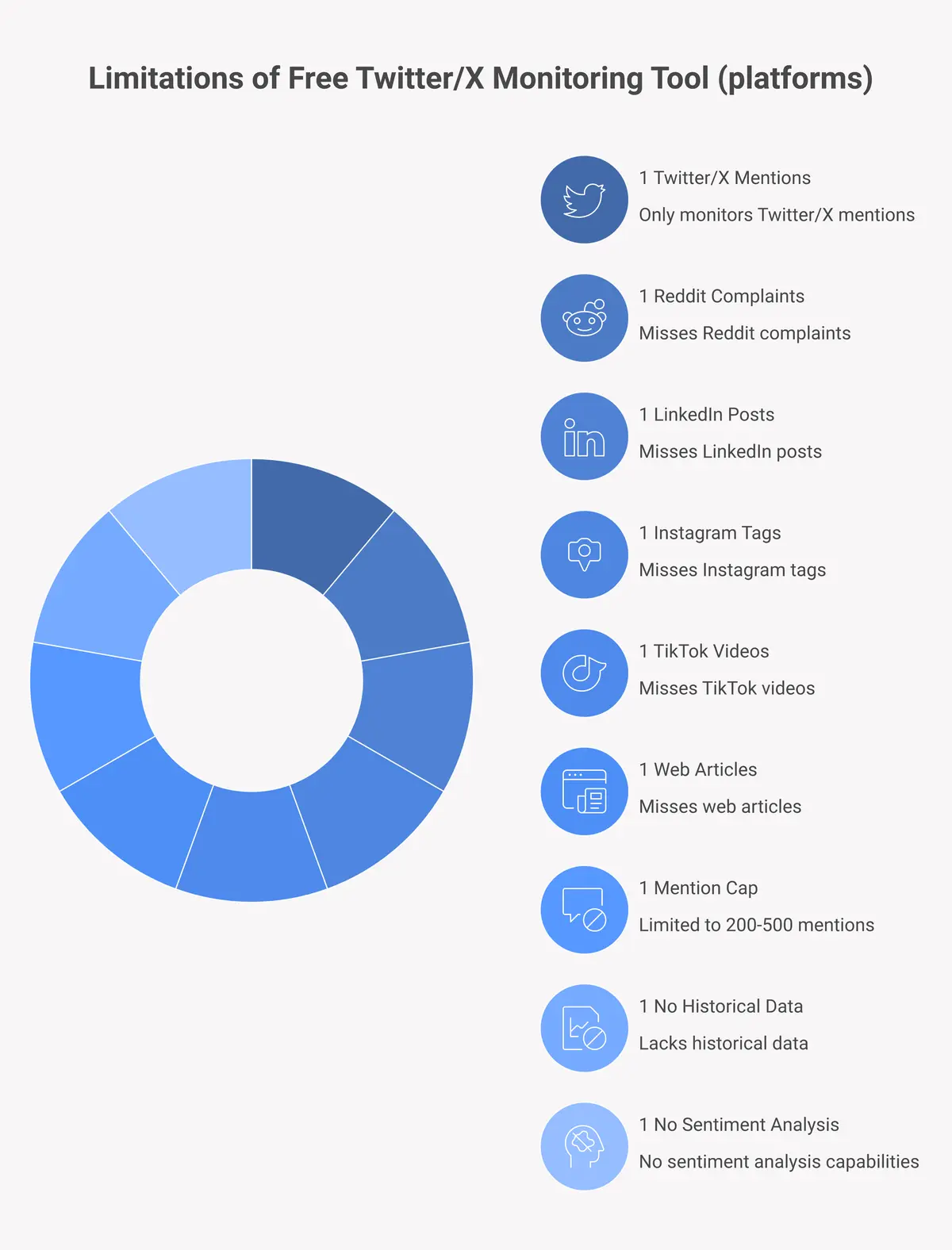
Free social media monitoring tools typically leave out five key features that matter most when your brand has real exposure: historical data access, adequate alert volume, LinkedIn monitoring, sentiment analysis, and team collaboration tools. Understanding these gaps helps you decide whether a free tool is genuinely enough or just a starting point.
Historical data: the past is invisible
Most free plans show you new mentions as they happen. They don't let you search backwards. That matters enormously when you're trying to understand a spike in mentions, track a product launch retrospectively, or investigate where a negative narrative started.
Paid tools typically provide 30 days to 12 months of searchable historical data. Free plans usually cap this at 7 days, or offer none at all. If you want to know what people were saying about you last month, a free tool won't help.
Alert volume caps: missing the crisis that matters
Imagine a PR problem starts on Reddit on a Friday evening. Within hours it gets 400 comments and cross-posts to two other subreddits. By Monday morning, a journalist picks it up.
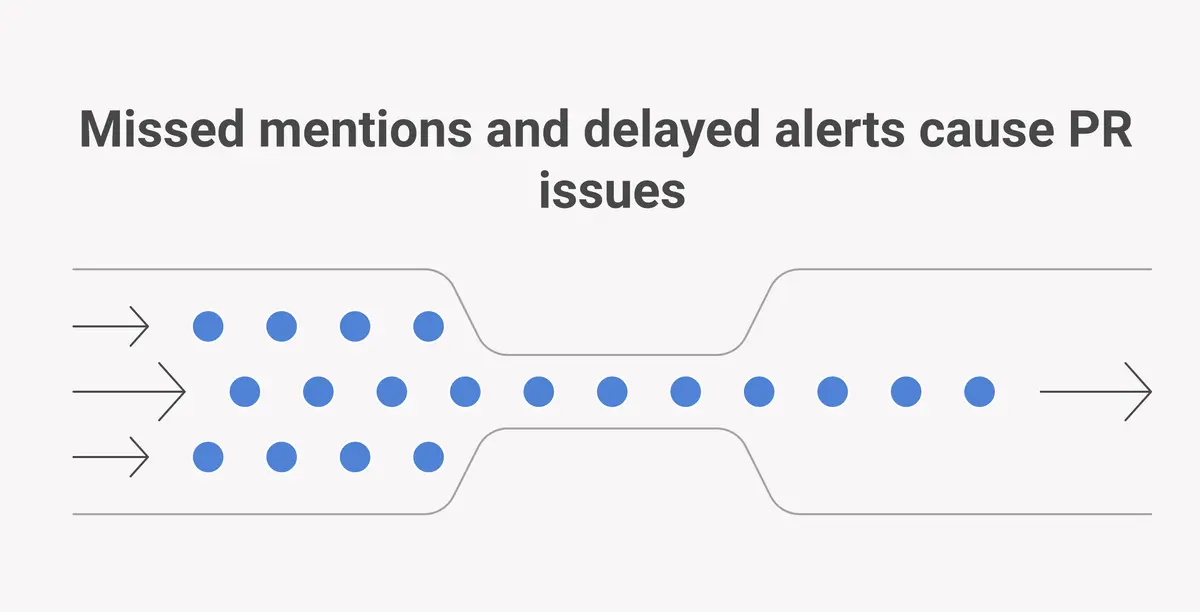
If your free plan caps mentions at 200 per month, you might never see it. Volume caps are one of the most dangerous limitations of free monitoring tools, because crises don't respect monthly quotas. The mentions that matter most often arrive in sudden, high-volume bursts.
Sentiment analysis: knowing if mentions are good or bad
Volume of mentions alone doesn't tell you whether your brand perception is improving or declining. Sentiment analysis classifies mentions as positive, neutral, or negative, so you can spot a shift in tone before it becomes a trend.
Most free tools skip sentiment entirely. You get a raw list of mentions with no indication of whether people are praising you or criticising you. For any brand managing its online reputation, this is a significant blind spot.
Free Social Media Monitoring Tools: An Honest Comparison
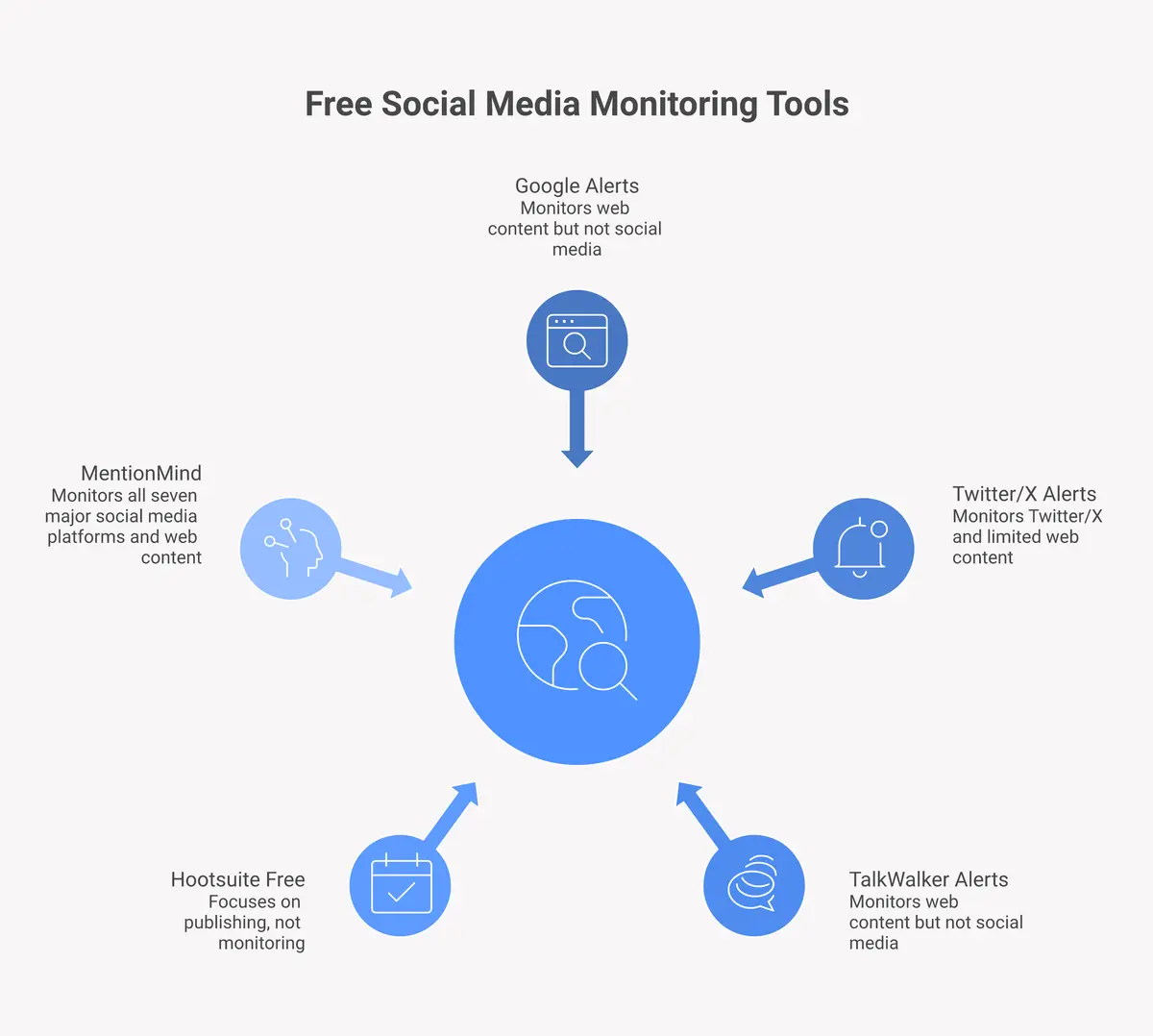
Not all free tools are the same. Here's what the most commonly used free options actually cover, and where each falls short.
Google Alerts
Google Alerts monitors web content only: news articles, blogs, and websites indexed by Google. It doesn't touch social media platforms at all. It's genuinely free with no caps, which makes it useful for tracking press mentions and blog coverage. But if you're looking for what people are saying on Twitter, Reddit, or LinkedIn, Google Alerts is completely blind.
Best use case: catching press and blog mentions. Not useful for: any social platform monitoring whatsoever.
Mention (free plan)
Mention's free plan includes 500 mentions per month across web and some social sources. That sounds reasonable until you realise that a single Reddit thread about your product can generate 50+ data points on its own. At 500 monthly mentions, a moderately active brand will hit the cap in the first week.
Platform coverage on the free tier is limited, and features like historical data search and sentiment analysis are locked behind paid tiers. Mention's free plan is a genuine taste of the product, but it's not a brand monitoring strategy you can rely on.
TalkWalker Alerts
TalkWalker Alerts functions similarly to Google Alerts: it covers web content and sends email notifications when your keyword appears. The interface is cleaner and results can be slightly more varied, but coverage is still web-only. No Twitter, no Reddit, no LinkedIn, no Instagram.
If you're already using Google Alerts, TalkWalker Alerts adds marginal value. Neither tool covers social media.
Hootsuite (free plan)
Hootsuite is primarily a social media scheduling and publishing tool. Its free plan lets you manage posts and a basic social stream, but serious brand monitoring capabilities are reserved for paid tiers. Hootsuite's plans page makes clear that social listening features are only available on Business and higher plans.
People often search for Hootsuite alternatives when they want brand monitoring. But Hootsuite was never primarily a monitoring tool. Its free tier is a publishing dashboard. Don't confuse the two.
When Is It Time to Upgrade From a Free Monitoring Tool?
You've outgrown a free social media monitoring tool when any of these are true: you're hitting monthly mention caps regularly, you have no visibility into LinkedIn, you've experienced a brand mention spike you couldn't track, or you're managing a brand with real business stakes attached to its reputation. At that point, partial monitoring creates more risk than no monitoring, because you believe you're watching when you're actually not.
Signs you're flying blind
Three concrete signals tell you a free tool isn't enough. First, you only find out about brand mentions when customers email you directly. Second, you had a PR situation you first heard about from a colleague, not your monitoring tool. Third, you're running paid campaigns across multiple platforms but have no system tracking the public reaction to them.
Each of these is a gap between what you think you know and what's actually happening. In brand management, that gap is where reputations erode.
What comprehensive monitoring actually looks like
A proper brand monitoring setup covers all the platforms your audience actually uses: Reddit, LinkedIn, Twitter/X, Instagram, Facebook, TikTok, and the web. It gives you historical search so you can look back, not just forward. It includes sentiment classification so you know whether a spike is good news or bad news. And it doesn't cap you at 200 or 500 mentions a month, because real brand visibility doesn't fit in a monthly quota.
MentionMind covers all seven platforms in one dashboard. That's one place to monitor your brand, your competitors, and the keywords your customers use across every surface where they're active.
How to Get Real Value From a Free Tool While You Still Can
If a free monitoring tool is where you're starting, that's fine. Here's how to extract the most from limited coverage before you outgrow it.
Stack free tools strategically
No single free tool covers everything, but you can partially compensate by stacking them. Use Google Alerts for web and news coverage. Use Reddit's own notification system for brand mentions in relevant subreddits. Use Twitter's advanced search to manually check for brand mentions weekly. Stacking three free tools gets you closer to full coverage than any one alone, though it still misses LinkedIn, Instagram, and TikTok entirely.
Use narrow, high-signal keywords
Free tools with mention caps go further when you monitor precise terms rather than broad ones. Instead of monitoring "social media monitoring," monitor your exact brand name, your product name, and your main competitors. Narrow keywords produce fewer, more relevant results that you'll actually act on before hitting the cap.
Build a manual check habit
A free tool running in the background is not the same as active monitoring. Build a weekly habit: search your brand name on Reddit manually, check LinkedIn for mentions of your company, look at Twitter's search for direct brand references. It's slow, but it closes the gaps a free social media monitoring tool can't fill.
When your brand grows to the point where weekly manual checks take more than an hour, or when you find mentions your tool missed, that's your signal to move to a plan with proper multi-platform coverage. Start monitoring all 7 platforms from one dashboard and stop flying blind.
Frequently Asked Questions
Is there a truly free social media monitoring tool that covers all platforms?
No free tool currently covers all major social media platforms. Free plans from tools like Mention or TalkWalker cover a limited selection, and none reliably include LinkedIn due to API restrictions. For full 7-platform coverage including LinkedIn, Reddit, Twitter/X, Instagram, Facebook, TikTok, and the web, a paid plan is required.
Does Google Alerts monitor social media?
No. Google Alerts monitors web content only, including news articles, blogs, and publicly indexed websites. It doesn't track any social media platforms. It's useful for press and blog coverage but not suitable as a free social media monitoring tool if you need visibility into platforms like Reddit, Twitter, or LinkedIn.
What is the difference between a free social media monitoring tool and a paid one?
Free tools typically cover fewer platforms, cap monthly mentions, offer no historical data search, and exclude features like sentiment analysis and team collaboration. Paid tools provide broader platform coverage, higher or unlimited mention volumes, historical data access, and analytics that help you act on what you find, not just collect it.
Why don't free monitoring tools cover LinkedIn?
LinkedIn restricts API access to third-party tools, making it technically and commercially difficult to include. The cost of LinkedIn integration is significant enough that most vendors reserve it for paid plans. For B2B brands where LinkedIn is a key channel, this is one of the most important reasons to consider a paid monitoring solution.
When should I upgrade from a free social media monitoring tool?
Upgrade when you're regularly hitting monthly mention caps, when you've missed brand mentions that mattered, when LinkedIn is important to your business and you have zero visibility there, or when manual platform checks are consuming more than an hour per week. At that point, the cost of incomplete information exceeds the cost of the tool.