Brand Crisis Monitoring: How to Catch a PR Problem Before It Explodes
Most brand crises didn't start as crises. They started as one Reddit thread. One tweet with 47 likes. One LinkedIn post from a frustrated customer that got more traction than expected. The crisis happened not because someone posted something negative, but because nobody was watching.
Incident response tools for brand management provide PR monitoring for communications teams, giving them the early warning they need to intervene before a small problem becomes a reputational disaster. This guide covers what to look for, how fast you need to move, and how to build a monitoring setup that catches problems in the first six hours, when they're still manageable.

What Are the Early Signals of a Brand Crisis?
The early signals of a brand crisis are almost always subtle: a small spike in negative mentions, a thread gaining more traction than usual, a keyword your brand doesn't typically appear next to showing up in the same sentence as your company name. Catching these signals requires monitoring that runs continuously across all platforms, not just the ones your team checks manually each morning.
The three pre-crisis warning patterns
Three patterns consistently precede brand crises. First, a sudden volume spike: mentions of your brand increase sharply in a short time window, usually 2-3 hours. Even if the content isn't clearly negative yet, a volume spike on its own warrants investigation. Second, a sentiment shift: your normal positive-to-negative ratio changes without an obvious positive campaign driving it. Third, cross-platform migration: the same topic starts appearing on multiple platforms simultaneously, a sign that organic amplification is already underway.
Any one of these patterns is worth investigating. All three appearing together means something is already spreading and you have a narrow window to get ahead of it.
The keywords that signal reputation risk
Beyond your brand name, set up alerts for combinations: your brand name paired with words like "scam," "fraud," "avoid," "disappointed," "lawsuit," or "complaint." These compound keyword alerts catch the specific type of negative conversation that tends to escalate rather than fade. They cost nothing extra to set up but dramatically improve your crisis detection speed.
How Fast Brand Crises Spread Across Platforms
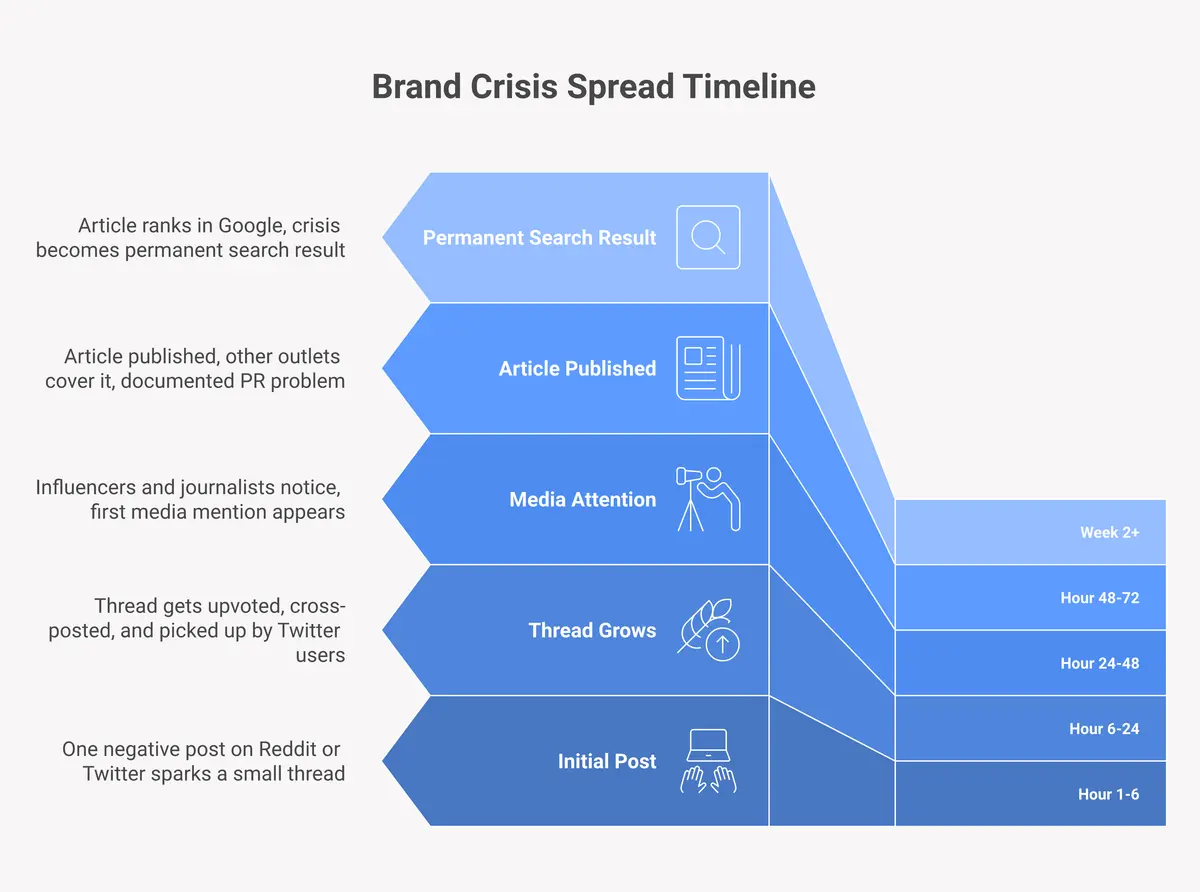
Brand crises spread faster than most communications teams expect. The journey from a single negative post to a documented PR problem with media coverage typically takes 48 to 72 hours when it involves a genuinely resonant issue. The brands that manage crises well aren't the ones with better crisis comms. They're the ones that found out in hour two, not hour 48.
The platform-by-platform spread pattern
Most brand crises follow a recognisable path. They typically start on Reddit or Twitter, where communities are vocal and threads get amplified quickly. From there, they migrate to other social platforms as screenshots and quotes circulate. Industry blogs and niche publications pick them up within 24-48 hours. Mainstream media coverage, if it comes, usually arrives 48-72 hours after the original post, by which point hundreds or thousands of people have already formed opinions.
The critical insight is that the media coverage isn't the crisis. The community conversation is the crisis. By the time a journalist writes about it, the narrative is already established, shaped by the first 24 hours of social reaction. That's when you needed to be visible and responding.
Why web monitoring matters as much as social
Industry blogs and niche publications often break brand stories before mainstream media. Web monitoring that covers news sites, blogs, and forums alongside social platforms gives you visibility into this second wave of coverage. A negative blog post with search engine traction is often more damaging long-term than a viral tweet, because it stays indexed and surfaces in Google searches about your brand for months or years.
How Do You Set Up Incident Response Tools for Your Brand?
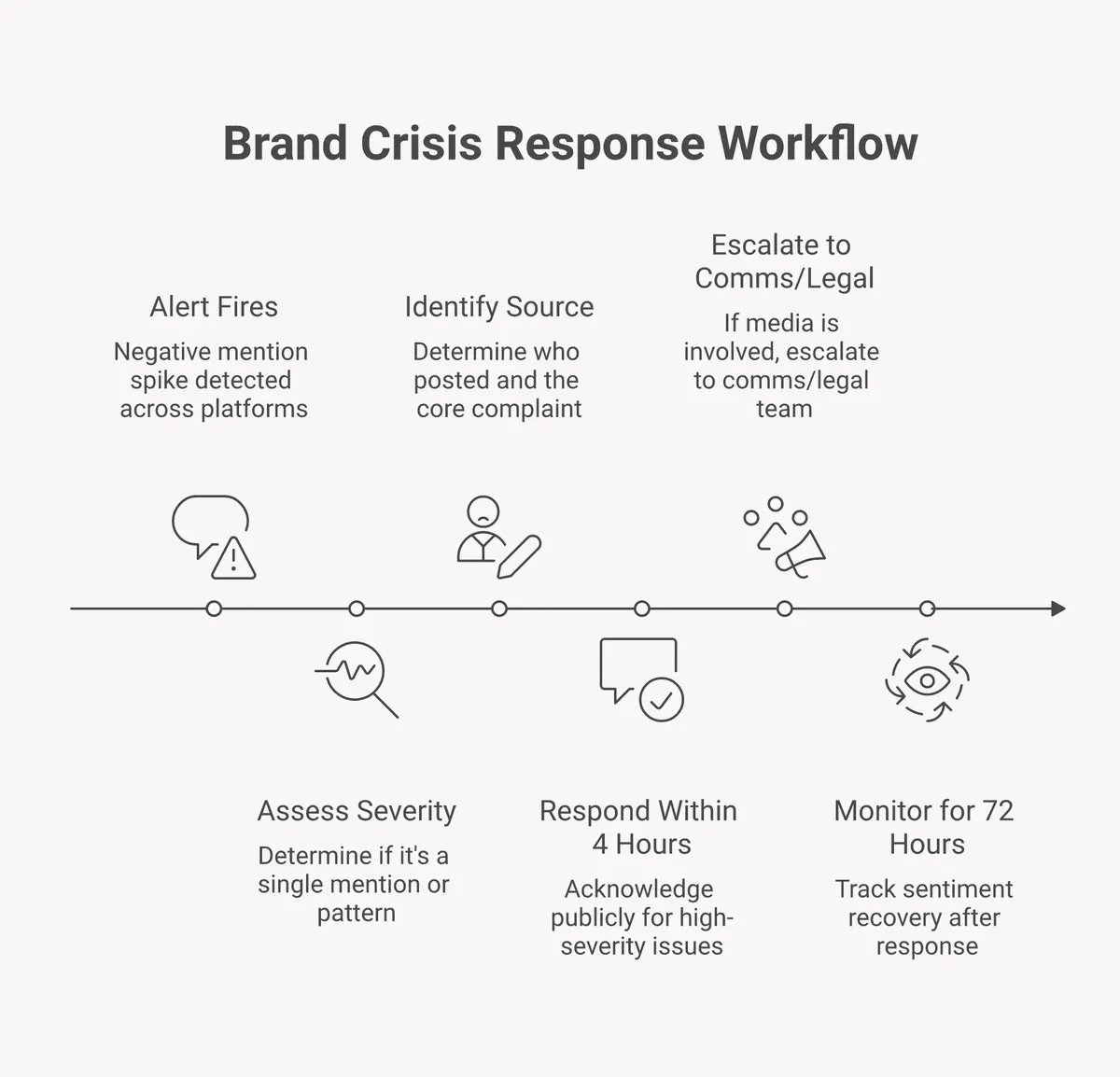
An effective brand incident response tool setup combines three components: continuous multi-platform monitoring, real-time alerting with defined thresholds, and a clear escalation workflow that tells your team what to do when an alert fires. The monitoring provides the data. The alerts provide the trigger. The workflow provides the response.
Step 1: Define your monitoring keywords
At minimum, monitor your brand name, your product names, and your CEO's name. Add compound risk keywords as described above: your brand name paired with high-risk terms. Consider monitoring your top competitors' names too, since their crises often create brand-adjacent conversations that affect your category.
Step 2: Set alert thresholds
Configure alerts for volume spikes (any 2x increase in hourly mentions relative to your 7-day average), sentiment shifts (any 20-point decline in positive ratio), and new platform appearances (first mention on a platform where your brand doesn't typically appear). MentionMind's brand monitoring dashboard lets you configure these thresholds for each keyword independently.
Step 3: Assign first responders
Define who gets the alert and what they do first. Typically this is a social media manager or communications coordinator who assesses severity within 30 minutes and decides whether to escalate to a senior PR or communications lead. The worst response to a monitoring alert is no response, which happens when alerts go to a shared inbox that nobody owns. Personal assignment with clear escalation paths is essential.
The Brand Crisis Response Playbook
A brand crisis response playbook defines the actions your team takes at each severity level, so there's no debate about what to do when an alert fires at 11pm on a Friday. Playbooks don't need to be complex. A one-page decision tree is often more useful than a 20-page crisis communications document that nobody reads during an actual crisis.
Severity classification
Classify incoming issues on a simple scale. Tier 1: isolated negative mention with low engagement. Monitor and log but no immediate action required. Tier 2: multiple negative mentions across one platform, engagement above your baseline. First responder investigates and prepares response options. Tier 3: cross-platform negative trend or direct media inquiry. PR lead engaged immediately. Legal consulted if applicable.
This classification lets your team calibrate their response without starting from scratch every time. Most alerts are Tier 1. Tier 3 events are rare, but when they happen, a pre-built playbook reduces response time from hours to minutes.
The 24-hour response window
For Tier 2 and Tier 3 issues, the first 24 hours are decisive. Acknowledging the issue publicly within this window, even before you have a full resolution, demonstrates awareness and care. Silence in the first 24 hours is often interpreted as indifference, which amplifies negative sentiment faster than the original complaint. A brief acknowledgement that you're aware and investigating buys time and reduces the amplification pressure while you work on resolution.
How Do Brand Teams Use Monitoring as a Crisis Prevention Tool?
The most effective use of incident response tools isn't crisis response. It's crisis prevention. A brand team that reviews monitoring data weekly develops an intuition for the small issues that could escalate if unaddressed: a product complaint that keeps appearing, a customer frustration that's mentioned by multiple unrelated users, a competitor criticism that keeps getting your brand dragged in as a comparison.
Proactive issue resolution
Many potential crises are neutralised long before they become crises by simply addressing recurring low-level complaints before they accumulate. A recurring complaint about your onboarding flow that appears in Reddit threads every week isn't a crisis yet. But if you address the underlying product issue, or even just respond to the thread consistently, you prevent the moment when someone makes a compilation post and the accumulated frustration becomes a news story.
Building institutional knowledge
Teams that have monitored their brand for 12+ months develop a detailed understanding of their risk profile: which topics generate disproportionate negative reaction, which communities are most critical, which types of content tend to go viral for them. This institutional knowledge and reputation management lets PR teams anticipate risk before it materialises, rather than reacting after it has. Review your monitoring plan and set up real-time brand crisis monitoring across all 7 platforms to close the gap between when problems start and when you find out about them.
Frequently Asked Questions
What is the difference between incident response tools for IT and brand crisis monitoring?
IT incident response tools manage technical security incidents: system outages, data breaches, and infrastructure failures. Brand crisis monitoring tools track public perception incidents: negative mentions, reputation threats, and PR problems spreading across social media and the web. The two are distinct product categories serving different teams (IT security vs PR/communications), though some brands use the term "incident response tools" to cover brand monitoring in the broader sense.
How quickly do brand crises typically spread on social media?
A significant negative post on Reddit can accumulate hundreds of comments within 6-12 hours. Cross-platform spread to Twitter typically happens within the first 24 hours. Media coverage follows within 48-72 hours for issues that resonate with a broad audience. This means the effective window for getting ahead of a brewing crisis is roughly the first 24 hours after the first significant negative mention appears.
What should I monitor to detect brand crises early?
Monitor your brand name, product names, executive names, and compound keyword combinations that signal reputation risk (your brand name paired with words like "avoid," "scam," or "disappointed"). Set alerts for volume spikes rather than just raw mention counts, since a sudden increase relative to your baseline is often more significant than any single mention in isolation. Monitor across all major platforms, including Reddit, because Reddit is where most viral brand crises originate.
Does web monitoring help with brand crisis detection?
Yes. Web monitoring covers news sites, industry blogs, and online forums that often break brand stories before mainstream media. A negative review on an influential industry blog or a critical forum post on a niche community site can drive significant search traffic to content about your brand. Web monitoring ensures you see these early signals before they appear in Google search results.
How many platforms do I need to monitor for effective crisis detection?
At minimum, Reddit, Twitter, and the web (news sites, blogs, forums). These three surfaces originate the vast majority of brand crises. For comprehensive coverage that also catches B2B reputation threats and influencer-driven issues, add LinkedIn, TikTok, Instagram, and Facebook. Multi-platform monitoring ensures that a crisis doesn't develop undetected on a platform your team isn't manually checking.